Write. Compile. Ship — For Video
Vibe-coding a 10-minute WWII documentary — where the script is the source code.
The Problem to Solve
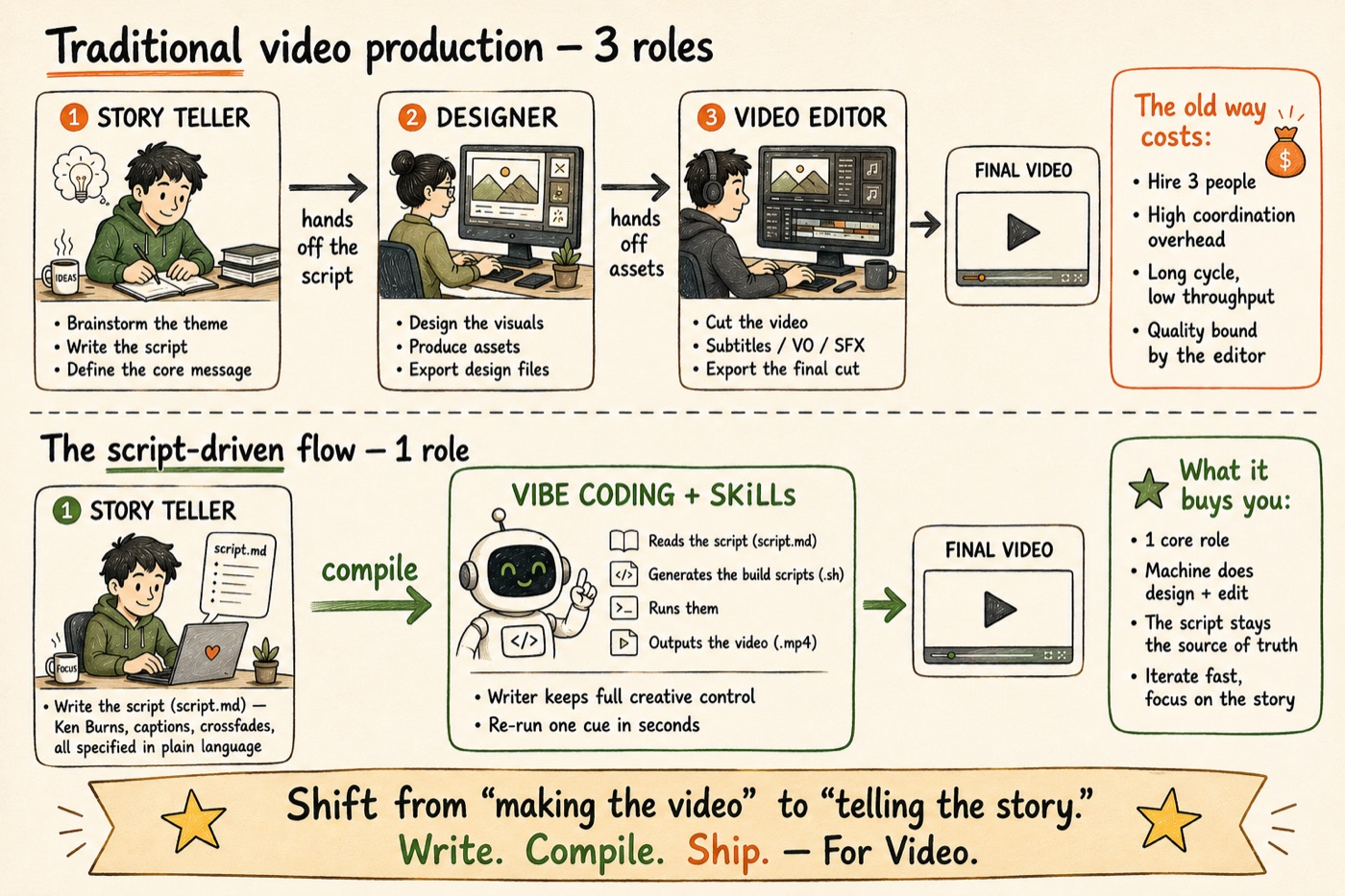
A screenwriter's job ends at the script. Dialogue, narration, scene directions, the occasional "slow push on this photo" — that's the deliverable. Turning those pages into a finished film has always been someone else's craft: an editor, a timeline, an NLE, and days of dragging clips and keyframing pans.
This project's goal is to optimize and automate the repetitive post-production work — to ask the writer to pour their creativity and imagination into finishing the script, and let AI compile that script into a finished video they're happy with.
The script stays the single source of truth. In this project that's script.md, with outline.md above it: the writer lays out cues, narration, and on-screen text exactly as before, and reaches for industry-standard language whenever they need it — "Ken Burns effect," "lower-third caption," "crossfade." No new authoring tool, no editor to learn.
The machine handles the rest. Vibe coding plus a set of SKILLs translates that human language into buildable shell scripts (.sh), and those scripts execute into the publishable .mp4.
It's the developer's loop applied to film. A Java programmer writes .java; a compiler turns it into something runnable. Here the writer's outline.md and script.md are the source; the project compiles them down to .sh; the shell runs and produces the video. Same shape — author in a human-readable source, compile, execute, ship.
What the Traditional Way Costs
Ten minutes of finished documentary is not a small thing. Industry rule-of-thumb pricing runs $1,000 per finished minute at the rock-bottom end, $2,000–$4,000 as a realistic starting point, and $10,000+ for television-grade — so a single ~10-minute chapter is a $10k–$40k+ project before anyone calls it broadcast quality.
An archival, stills-and-narration chapter like this one skips the film crew, but the budget just moves: into research and archival licensing, a scriptwriter, a narrator, and — the big one — a motion-graphics editor hand-animating every photograph. Editing runs $75–$150 an hour, and custom-animation passes routinely top 40 hours — and ten minutes of Ken Burns moves, burned-in captions, spotlight reveals, and crossfades is a lot of custom animation.
It also takes three people passing work down a line: the storyteller writes, the designer builds the visuals, the editor cuts. Every handoff carries a communication cost — a place where intent leaks and the calendar slips into weeks.
Cost benchmarks (2025–2026): per-finished-minute documentary pricing from Desktop Documentaries, Wind & Sky Productions, and Academy Voices; editing and custom-animation rates from Vidico.
The New AI Way
You write a cue, you ask for a build, you watch the clip. That's the loop.
A cue in script.md reads like what a writer already jots in the margin: the photo or footage to show, the narration line, the on-screen caption, and the motion — "Ken Burns push toward the bridge," "lower-third: Summer 1941 · San Francisco," "crossfade into the next shot." Plain language, plus the industry terms the writer already knows.
Then you tell Claude Code to build it. Vibe coding turns the cue-sheet into build_clip.sh, runs it, and hands back clip.mp4. Don't like the third shot? Change a line of narration, or swap "zoom-in" for "pan-up," rebuild just that cue (CUE=3 bash build_clip.sh), and re-watch in seconds. Stack the finished clips into the full chapter the same way.
No timeline, no keyframes, no round-tripping assets through a designer. The writer stays in the script the whole time — the screen just keeps catching up to the words.
Under the hood it's a bottom-up pipeline — shots compose into scenes, scenes into the film:
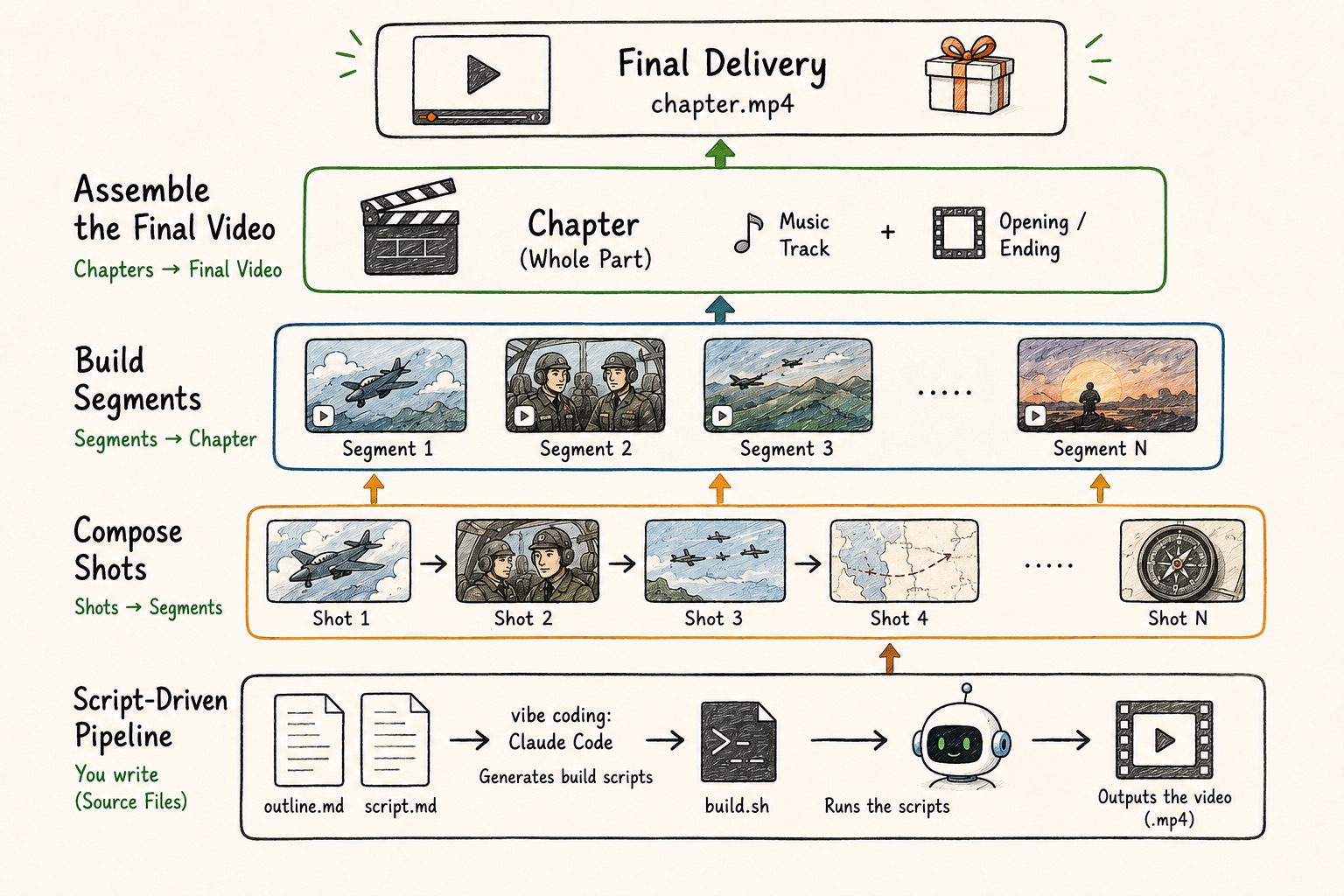
chapter.mp4.End to end, the writer touches three things and the machine handles the rest:
- Write — lay out the story in
outline.md, then the shot-by-shot cues inscript.md: image, narration, caption, motion. - Gather — drop in the photographs and archival clips; the narration is synthesized from the script's lines via text-to-speech.
- Direct & build — tell Claude Code to build. It writes
build_clip.sh/build_chapter.shfrom the cues and runs them; you review a cue, tweak a line, rebuild it (CUE=n), and repeat. Chain the clips into the chapter — out comes the.mp4.
Here is one cue, start to finish — a single shot described in script.md, then narrated, captioned, and animated by the build:
The New AI Workflow
That three-person line collapses to one. The writer keeps their seat; the designer's and editor's work is absorbed by the machine, which builds the visuals the moment the script asks for them. No handoffs — so nothing leaks in translation, and nothing waits in a queue.
Iteration drops from hours to seconds. Re-cutting a shot in a timeline means re-importing, re-keyframing, re-exporting. Here you change one line in script.md and rebuild that single cue — the rest of the film is untouched and never re-renders. Trying five framings of the same photo costs five small commands, not five round-trips through an editor.
And the source of truth never moves. Every change is a diff on a text file: reviewable, reversible, versioned in git like code. There's no final_v3_REAL.prproj — the script is the project, and the video is just its current build.
Put rough numbers on it. This chapter is ~9m44s built from 41 photographs, 7 archival clips, 20 narration cues, and ~67 edit operations — Ken Burns moves, captions, spotlight reveals, crossfades. That is squarely the $10k–$40k+, three-people, several-weeks job from above. Here it was one person directing Claude Code, iterating in days, not weeks — and the designer-and-editor line items, normally the bulk of that budget, shrink to near-zero marginal cost: a Claude Code subscription and a few dollars of text-to-speech, not a crew on day rates. (Effort here is estimated from the finished piece, not a logged timesheet.)
Why Re-Invent the Wheel?
Fair question. The short answer: this isn't a new wheel for its own sake — it's about building a better one, and making the building itself more efficient. I tried the existing tools first; each came close and stopped short.
 Descript — I liked the direction: edit the video by editing the text. But it blends a developer's and a screenwriter's mental models into one, and that mix didn't fit my purpose. Close, not quite.
 CapCut — genuinely one of the best for social-media video, with a deep template library. That's also the point: it's built for mass output and quick turnaround, not for one-of-a-kind creative work. Its pre-AI design means the workflow still leans on a lot of manual human care — it can't be driven and streamlined by an agent; its programmable entry points are still immature, and the weight of its existing design makes it hard to adapt at a fundamental level to where AI is heading in 2026.

 Text-to-speech (ElevenLabs vs. Fish Audio) — both work, and both clear the bar of acceptable. I picked Fish Audio because it handled the Chinese narration better. Neither is easy to push all the way to convincingly human yet — but Fish Audio is actively building out a programmable API, which is exactly what matters when the whole point is an automatable pipeline, so it's the one I'd bet on.
Claude Design — Anthropic's brand-new visual tool (research preview from Anthropic Labs): describe what you want and it generates designs, prototypes, slides, and marketing collateral. I tried it the day it launched, and the first demo genuinely wowed me. But Anthropic is candid that this is still the "research lab" stage — and that's exactly how it feels: the features are thin, the experience rough, and for a pipeline like mine it doesn't yet clear even the basic bar. The most AI-native of the bunch, and still the earliest. Exciting direction; not ready.
The common thread: the existing tools are either not programmable or not built for an AI to drive end to end. That gap is what the script-as-source-code approach fills.
Open Source
Everything here is open source — if you're curious, clone the repos below and rebuild the film.
video-production-kit — the reusable engine. 20 standalone shell recipes (ken_burns.sh, caption_overlay.sh, crossfade.sh, subtitle_burn.sh, text_spotlight.sh, and more), 7 reference docs (the end-to-end pipeline, the cue-format spec, ffmpeg/zoompan and text-rendering deep-dives), plus a project bootstrapper — all dependency-free bash. Use it as a toolbox for one-off shots, or to scaffold a whole documentary series.
AIeditor · Flying Tigers — this worked example, and a feel for the real complexity behind ten minutes: 41 historical photographs, 7 archival clips (cut from 2 newsreels), 20 narration tracks, and 2 music beds, composed across 4 clips plus opening and closing cards by 7 build scripts — roughly 67 edit operations in all. Clone it next to the kit and run the builds to watch the whole thing assemble.
The Takeaway
It's worth being honest about what didn't change.
This project's example is a historical documentary. A high-quality documentary still earns its accuracy the old way: finding the right archival photo, dating the newsreel, confirming the man in the frame is who the caption says he is. AI shortens the mechanical parts — fetching footage, pulling auto-captions as a translation source, drafting a search — but the judgment of what is true, and what is worth showing, stays human. Vibe coding compiles the script faster; it does not do the research for you — the kind that takes invention and depends on a human flash of insight.
And the creative core is untouched — because it's the whole point. The pacing of a reveal, the narration line that lands, the choice to hold on a face for one more beat: that is the screenwriter's craft, and it is exactly what this pipeline is built to protect. The machine took over the parts a writer never wanted — the keyframing, the re-exports, the handoffs — so the parts only a human can do get all the attention. Top-quality work was never bottlenecked on the editing. It was bottlenecked on the storytelling, and it still is.
That's the trade worth making. Write. Compile. Ship — and spend the time you save on the story.
Watch the finished chapter (~9m44s):
Built with

video-production-kit