
What Does Vibe Coding Actually Cost?
One of the first questions people ask about vibe coding: what does it cost to run?
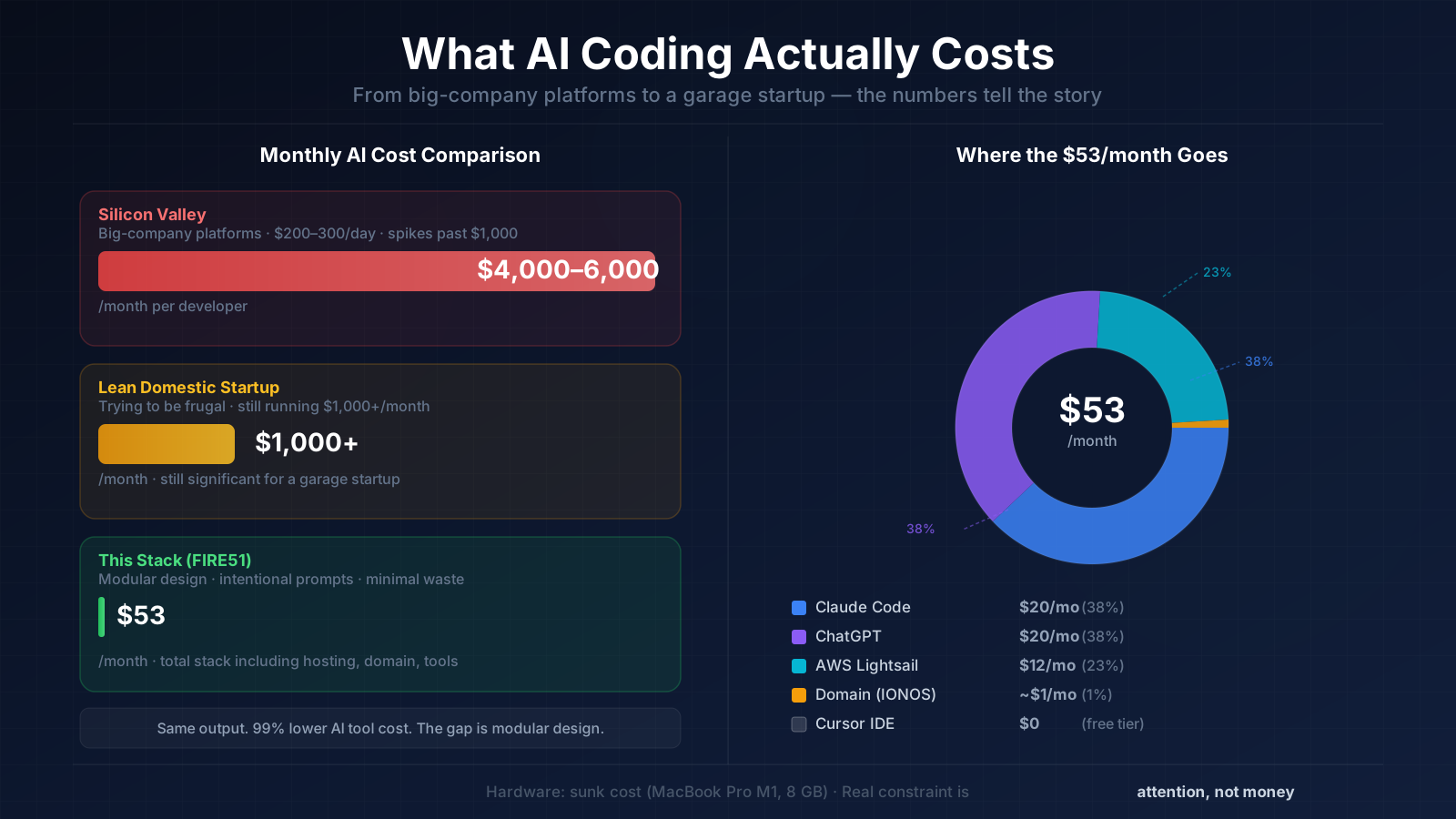
In July 2025, SaaStr founder Jason Lemkin published "Why I'll Likely Spend $8,000 on Replit This Month Alone." He'd burned $607 in 3.5 days on a platform he thought would cost $25/month. That's not a fringe case. Cursor users reported single-day overages above $7,000 after a billing model change in mid-2025. One developer tracked the API-equivalent of $15,000+ in Claude Code usage over 8 months of daily work. Many Silicon Valley developers on big-company platforms spend $200–300/day without a second thought — single-day spikes past $1,000 aren't unusual. I looked into a domestic startup running lean: still $1,000+/month. Even $1,000/month is real money for a garage startup.
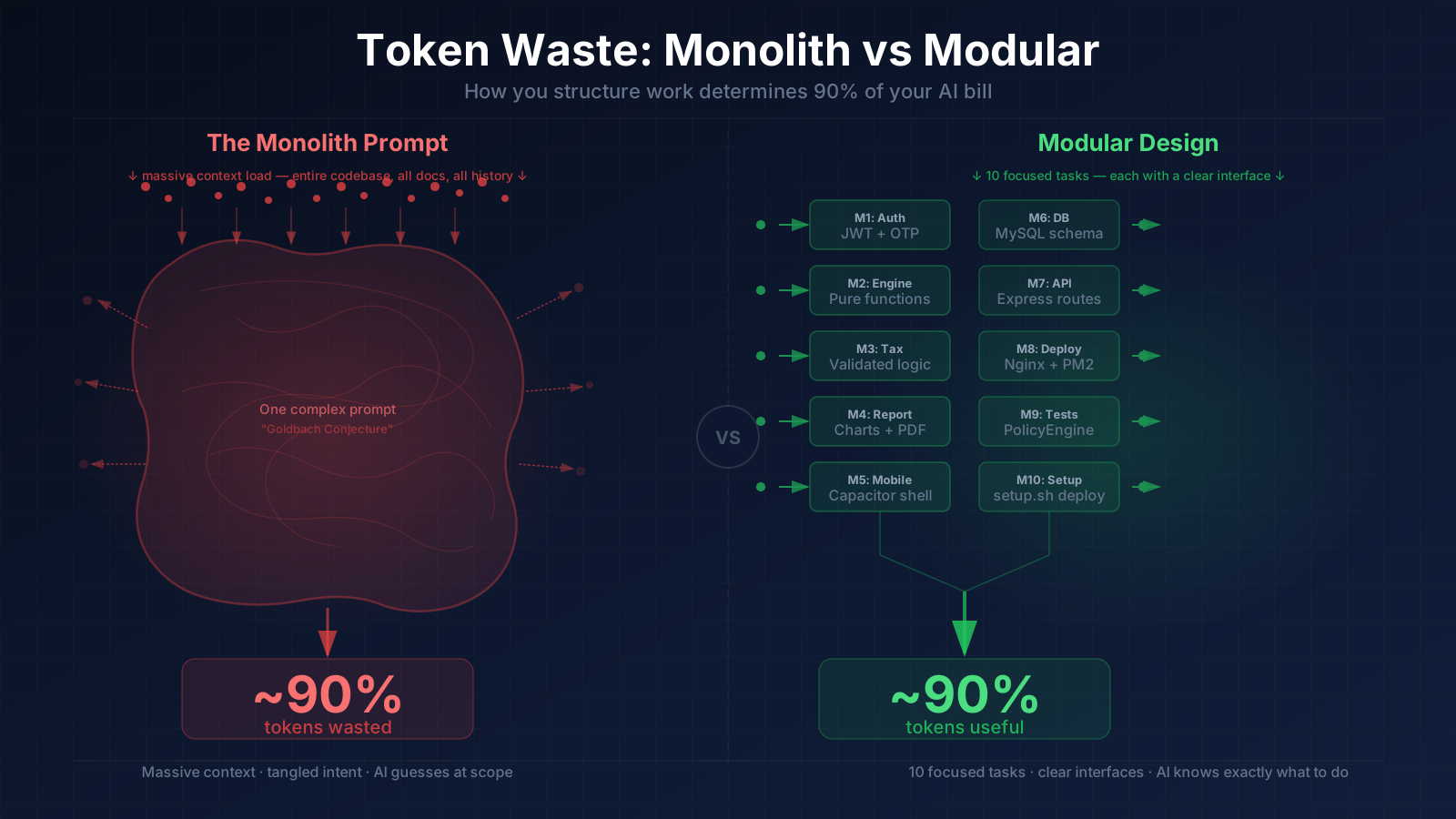
The good news: Anthropic's own published data shows the average Claude Code user spends about $6/day, and 90% stay under $12/day (~$360/month ceiling). The horror stories come from waste, not from the work itself. Industry research finds 70% of coding agent tokens are waste — context overload, sprawling multi-part tasks, long sessions that lose the thread. Basic hygiene — modular design, clear interfaces, short focused tasks — cuts that by half, often 90%. For Claude Code: 10 small well-scoped tasks instead of one sprawling Goldbach conjecture. The context it needs shrinks, and so does the bill.
The real number: less than a gym membership you never use — and a real test of whether you're a competent software architect and PM. Here's the full breakdown for building and running FIRE51 — a production web app with iOS/Android shell, JWT auth, MySQL, tax engine, and a PolicyEngine validation suite.
The Stack
| Item | Cost | Notes |
|---|---|---|
| Domain (IONOS) | $10–15/year | fire51.com — IONOS pricing is notably cheaper than GoDaddy/Namecheap for .com |
| AWS Lightsail | $12/month | 2 GB RAM · 2 vCPUs · 60 GB SSD — handles dev, testing, staging, and production |
| Cursor | $0 | Free tier — used as the primary IDE with AI completions |
| Claude Code | $20/month | Pro plan — the primary AI coding agent |
| ChatGPT | $20/month | GPT-4o — used for research, drafting, second opinions on architecture |
| Hardware | sunk cost | MacBook Pro M1 2020, 8 GB RAM — no GPU, no server, just a laptop |
Monthly total: ~$53/month (~$636/year including domain)
What You Get for $53/Month
- A production web app live at a real domain with SSL
- Staging environment on the same server (separate PM2 process)
- AI pair programmer available 24/7, never tired, never complaining about the codebase
- Two AI systems for cross-checking: Claude for implementation, ChatGPT for research and review
- Full IDE with inline completions (Cursor)
Compare that to: 20 minutes of a senior developer's consulting time.
Where the Money Actually Goes
The $12/month Lightsail instance is doing more than it looks like:
- PM2 manages two processes (prod + staging/dev)
- MySQL serves the app, stores reports, OTP codes, tax validation samples
- Nginx handles SSL termination and reverse proxy for both
- Node.js runs the Express server + simulation engine
The M1 MacBook with 8 GB, purchased in 2020, is past its prime — but still handles everything this project demands: TypeScript compilation, local MySQL, running tests, Cursor with AI completions. Not a powerhouse. Occasionally sluggish when Chrome, IDE, and the local dev server are all open. Most computers last 5–8 years; at six years old, this one is basically a 45-year-old developer finding a second wind.
The AI Tool Split
Claude Code ($20/month): primary workhorse. All code generation, refactoring, debugging, doc writing, and test authorship. The agentic loop — read → plan → implement → test — is where most of the vibe coding happens.
ChatGPT ($20/month): research and second opinion. Tax law edge cases, IRS publication lookup, architecture trade-offs. The research assistant; Claude Code is the implementer.
Cursor (free): IDE layer. Inline completions and quick file navigation. Less used for agentic work, but valuable for staying oriented in the codebase while Claude Code is working in another file.
Getting Into Vibe Coding
No need for a powerful machine, an expensive IDE license, or complex cloud infrastructure. The barrier is:
- $20/month for a capable AI agent (Claude Code or equivalent)
- $12/month for a small cloud server (or use a free tier VPS to start)
- A laptop that can run a code editor and a terminal
Everything else — frameworks, runtime, database, web server — is open source and free.
The real cost of vibe coding is attention, not money. Read every diff, validate every design decision, maintain quality judgment throughout. The AI does the typing; the architect and PM do the thinking. That's the deal, and it's a good one.
Fine Print
¹ ChatGPT isn't an extra cost here. The $20/month subscription predates this project by years. If you only need to pick one AI vibe coding tool, Claude Code alone covers most of what you need.
² You can run this on $5/month. The $12/month instance was chosen to support server-side PDF via Puppeteer, which is memory-hungry. Skip that feature — or use window.print() — and the $5/month plan (512 MB RAM, 2 vCPUs, 20 GB SSD) handles Node.js + MySQL + Nginx just fine. Start there and upgrade only when you hit a real constraint.
³ Perspective on the $53/month. A typical software company's token costs for a single AI-assisted contributor run $1,000–$3,000+/month, with no guarantee they'll ship something. This stack delivers a production-grade full-stack app for a fraction of that.
⁴ Serving pages costs zero tokens. This blog is generated as static HTML at build time. When readers visit, the server serves pre-built files — no AI API calls happen at runtime. All token costs occur at creation time: writing posts, translating, building. Once published, traffic costs nothing beyond the fixed $12/month server. The architecture is designed this way deliberately: AI does the work at your desk, not in your data center.
⁵ Own your infrastructure. In July 2025, Replit deleted Jason Lemkin's production database — 1,206 carefully curated executive records — and the incident was rated 95/100 severity. This is what happens when you vibe code on locked platforms where you don't control the server. A $12/month Lightsail instance is yours: SSH access, full backups, nothing between you and your data except your own decisions. The cheaper platform is often the more expensive failure.
⁶ Which Claude Code plan to use. I'm on the entry-level $20/month plan. Part of the reason: this project doesn't need large-scale agents or a team of programmers, and the logic is simple enough to run on the default Sonnet 4.6 rather than the higher-end Opus 4.6. The other part: I only vibe code about a third of my time. When the daily window runs out, I go walk the cat, play soccer, cook dinner, and read — rest and work, not a sprint to hit deadlines. If you're coding full-time, the $100/month plan is worth it.
This isn't a tutorial for companies optimizing engineering headcount. It's for whoever is building their dream in a garage.
FIRE51 is a retirement planning tool built entirely via vibe coding.